Friday, 12 July 2019

MADAGASCAR


PART TWO: FLORA & FAUNA OF THE HIGHLANDS


I have just finished a 6 hour hike through the rainforest. I'm smiling because I'm not aware that there are leeches all over my legs having a banquet.


A futile attempt to dry my belongings. 


Let's Talk About Lemurs

Ring-tailed lemur

Once upon a time, millions of years ago, Madagascar was part of the African continent. When it broke away, it took lemurs with it. Lemurs are primates that evolved in isolation on the island of Madagascar after the big divorce. There are actually about 100 different types of lemurs, but the entire species is considered endangered. Because the different lemur types often eat different types of food, they can co-exist peacefully in the same patch of forest. Too bad the same can't be said of the human species....


My first lemur-spotting was in Ramomafana National Park. After a long drive, we arrived at Hotel Cristo, outside the park. After dropping off my bags, we set off for a 'night walk.'


We drove into the little town that has grown up on the edge of the park, and waited for the guide. We didn't actually go into the park, just drove past the town and got out and walked along the side of the road, looking for lizards. True story. 


Leaf-tailed gecko,a master of camouflage


Luckily I had booked two nights at the hotel in Ramomafana, because the first day it bucketed down. There was no point going into the forest to look for lemurs. They would be sensibly hiding from the weather. So I tucked in and drank tea and read two books.  In the afternoon, the rain slowed down a bit, and I had a bit of a wander in the garden. 


The next day the sun wasn't shining, but there was only a slight drizzle, so we set off to look for lemurs in the forest. My guide was the same man from the night before, Emile. Emile was one of the people who helped Dr.Patricia Wright discover the Golden Bamboo Lemur in 1986. Ramomafana Park was actually created to protect this particular lemur. 


I love the rainforest. I'm always astonished by the creative genius of nature. Everything in the rainforest is there for a reason. Every creature and plant plays a part in the intricate dance of life. 


Before we even entered the park, Emile showed me the most astonishing creature; another leaf-tailed gecko.


See it? 


After a few minutes of walking, Emile heard or saw something and suddenly we were off the path, picking our way through undergrowth. We were on the hunt!!! 


There are only about 600 Golden Bamboo Lemurs in the wild. They all live in this forest. They are the cutest creatures imaginable, and I am so lucky that I got to spend time watching a few. I could have stood there all day. 


Who knew that a diet of bamboo shoots could lead to such a big bottom? 


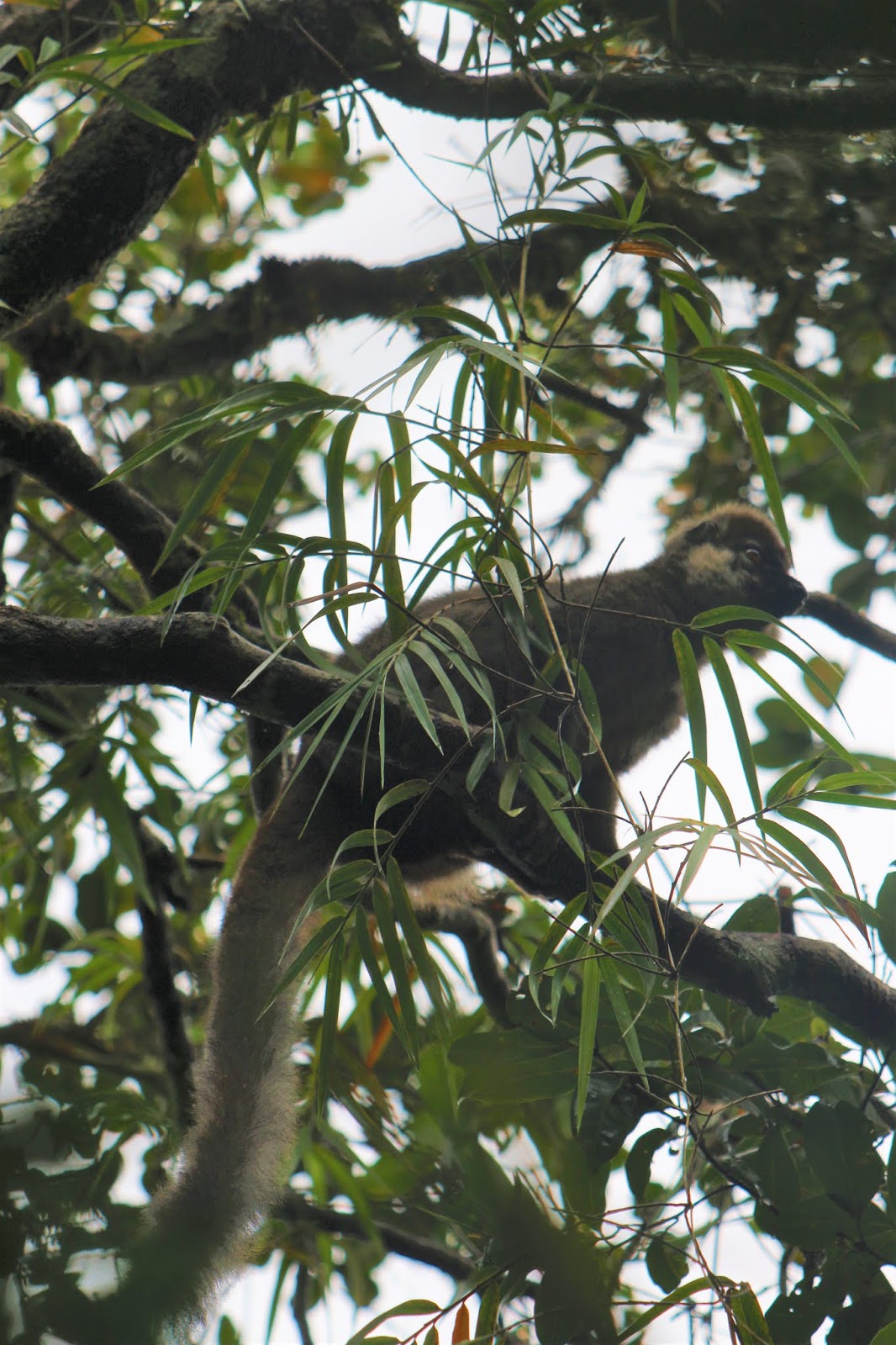
Emile the guide dragged me away, because there were more lemurs to see. More muddy paths to climb and descend. The next lemurs he discovered were red-fronted brown lemurs. These guys were much shyer, and stayed in the tops of the trees. 


More slogging up and down muddy hills (I have to admit at this point I was wondering why the HELL I was torturing myself like this just to look at monkey butts) to discover the white and black lemur. 


But I do it for this: to be able to see the wonders of nature in this incredible world of ours. 


After the hike, I went back to the Hotel Cristo for lunch and to change before heading to Ambabavalo for the night. This is when I discovered blood caked all over my legs, and had to forcibly remove a stubborn leech from my knee. Later on I discovered blood on the back of my tshirt.  I single-handedly supplied an entire army of leeches with sustenance that day! 


Outside of Ambavalo, we stopped at Anja Park, where I got to spend time with a group of ring-tailed lemurs. And some reptiles, and a gorgeous Madagascar Hoopoe. 


Saturday, 6 July 2019

MADAGASCAR!!!!


Part One: Central Highlands


Enjoying (with a little bit of nervousness) the incredible view at Isalo National Park


Madagascar has been on my bucket list forever. And no, I haven't seen any of the animated movies...So this summer I did it. I booked my flight, waited for a VERY long time for the Lonely Planet guide to arrive in Istanbul, and started planning! 


I gave myself a full month to explore Madagascar. When I first went through 'the book' and started writing down what I wanted to do and see, I was up to two months worth of travel before I had gotten very far. So the editing began. 


I decided to break the trip down into three parts: the Central Highlands, a small part of the west coast, and Ile Sainte Marie on the east. I started in the Central Highlands. 


The roads in Madagascar are dangerous. The main highway that runs south from Antananarivo is called the N7. It is narrow, winding, and has potholes aplenty. For this reason, most car rental places insist that you hire a driver with the car. I organized an 11 day trip through Madagascar Tour Guides. I actually had a driver and a guide for this part of my trip. Solomon, the driver, doesn't speak English or French, so Hube, an English speaking guide, came along for the ride. 


My chariot for the first part of my Madagascar adventure


Hube and Solomon were wonderful. They were respectful, extremely professional, and very concerned about my well-being. They taught me a few words of Malagasy, and were very kind about my destruction of their language. Any time I wanted to stop for photos or toilet breaks, Solomon complied. 


As I mentioned above, the roads in Madagascar are not great. Solomon is young (about 26), but I had complete trust in his driving ability. There were a few times when I closed my eyes but I knew he was in complete control of the vehicle. He had an astonishingly accurate knowledge of the amount of space he needed to maneuver the vehicle. Madagascar drivers may be the most co-operative I have ever witnessed ANYWHERE in the world. Whenever Solomon came behind a slower moving vehicle, the driver would always signal if it was safe to overtake. Solomon would give a little toot, and the vehicle ahead would move to the right a tiny bit. There is no aggression, no competition, no road-hogging. 


The big truck to the left had a flat. Slowly, slowly, traffic was being moved past it in both directions. The road was lined with people watching and probably giving advice. The three guys working on the tire were sharing a cigarette. I was SO glad I wasn't in the truck in front of us.


The scenery in the central Highlands is breath-taking. Unfortunately, part of that visual beauty is due to the massive deforestation that has happened here. The country has lost EIGHTY PERCENT of its primary forest cover. I'm sad to say that Madagascar represents a blueprint of how to take a rich, unique environment with so much potential and destroy it. 


The land is rich and arable. People in the highlands grow rice, wheat, corn, fruit, an incredible variety of crops. The people are ingenious and work SO hard. I saw men pulling wagons of produce, home-made carts with steering devices for moving goods up and down the mountains, 'machines' made out of scraps of wood and bedsprings for creating wooden art. The people here fix EVERYTHING. Nothing is wasted. Many of the people I met here speak at least 3 languages; Malagasy, French and English. 


HOWEVER, Madagascar is plagued by corruption. The forests (including slow growth hardwoods like rosewood) have been ravaged, often with the blessing of the government, with the inevitable destruction of wildlife habitat, erosion, rivers destroyed by silt run-off. At least SEVENTY-FIVE PERCENT of Madagascar's population lives in poverty, 'surviving' on less than US$2/day. Only 65% of the population is literate. It is heartbreaking. 


These men rent these rickshaws for about US$2.50/day. They operate purely on human power. A ride costs about 13 cents. The men need to have about 20 paying passengers during the day just to pay the rent. 

Madagascar had a presidential election in November 2018. The man pictured on this t-shirt was the winning candidate. Prior to the election, helicopters were used to distribute t-shirts, scarves, and skirts emblazoned with his photo to villages in the countryside. Diabolical but genius. His likeness was literally plastered across the chests and backsides of people all over the country. When people went to vote, his was most likely the most recognizable face on the ballot.


The main road goes through village after village on the way south. The road was always crowded with people, often going to market. Solomon would slow right down, toot his horn occasionally, and people would move out of the way. The biggest problem were the chickens and geese who didn't seem to realize that a two-ton vehicle was bearing down on them.


A house typical of the Merina people. They are very superstitious, so houses are oriented in specific directions. The North-east corner of the house is devoted to the ancestors. Windows and doors always face the west.


The zebu is probably the most important animal in the lives of the highland people.  It is a meat source, a labour source, it is sacrificed for special occasions, and is calculated in the bride-price. (My guide in Isalo National Park gave his bride's family the equivalent of the cost of one zebu when he married). Light coloured zebu are sacrificed for happy occasions like weddings, and dark-coloured animals for funerals. In the south, the Bara people are infamous as zebu rustlers. The zebu looks like a cow, but has a large distinctive hump on its back. This hump is fat, like the hump on a camel's back. The history of the zebu is mysterious. It may be a hybrid of animals brought by ancestors from Indonesia and Malaysia and Africa. Or it might just be the descendant of animals brought from Africa.


This boy kept a close eye on me when I jumped out of the vehicle to photograph his zebu.


This man is wearing the distinctive dress of the Merina people, the fedora and the blanket tossed casually over the shoulder. It was winter when I was here, and the people in the highlands consider it cold. I saw people wearing jackets and scarves, and one child in a snowsuit!!!!


This gentleman designed and built this marqetry machine. Marquetry is the art of fitting different pieces of wood together to form a picture.


Silkworms that live on these trees (called Tapia) are collected for Malagasy silk.

Natural ingredients used to colour Malagasy silk.


The bark from this tree is used in a paper-making process

The bark is soaked for a number of days,then beaten. The amount of pulp in the ball is what they need to make a piece of paper the same size as what is shown behind the table. 


petals and leaves are placed onto the wet paper


The finished product, wet and dry